
Bible Study
How to Study the Bible with the SOAP Method
A simple four-step method for slowing down, understanding a passage, and putting it into practice.
Many of us have opened the Bible with good intentions, read a passage, and realized a few minutes later that we skimmed right over it. When we do not understand what is happening, it is easy to keep moving without grasping what the passage says or why it matters.
The Bible is meant to be read, but careful study helps us slow down and discover deeper truths about God. It also helps us respond faithfully instead of leaving what we read on the page. This guide explains a simple Bible study method that anyone can use, whether you are a new believer or have studied Scripture for years.
What is a Bible study method?
A Bible study method is a set of principles, tools, and steps that guide us as we examine Scripture. There are many useful methods, each with a slightly different emphasis. In this article, we will use SOAP because it is easy to remember and effective at helping us understand Scripture and apply it to our lives.
SOAP stands for Scripture, Observation, Application, and Prayer. As we work through each step, we will use Romans 12:2 as an example. Let's dive in.
Scripture

Choose a passage and read it several times. If it helps, write it out by hand or say it aloud. Both practices force you to slow down and process the wording more intentionally. Your passage might be one verse or a few paragraphs, depending on the time you have.
Do not isolate the passage from its context. Once you have spent time with the passage itself, read the surrounding paragraph and chapter. Learn where that section fits within the book so you can follow the author's train of thought. Context is especially important when a passage begins with a word such as “therefore” or “for,” since those words directly connect it to what came before.
Romans 12:2 belongs with Romans 12:1, which begins, “Therefore I urge you, brothers, on account of God's mercy.” The “therefore” points back to Romans 1 through 11, where Paul explains the depth of God's mercy in saving undeserving sinners. Romans 11 closes with praise for God's wisdom and mercy. Romans 12 then turns toward the life that should follow from receiving that mercy. Reading Romans 12:1-2 together keeps verse 2 connected to that larger movement.
Observation
As you meditate on a passage, questions will probably arise. What does this word mean? What is the passage saying theologically and practically? Where do the same themes or principles appear elsewhere in the Bible? Observation is where we do our best to answer those questions while keeping the passage itself at the center.
Types of study tools
Different tools help answer different kinds of questions:
- Bible dictionaries define biblical words, people, places, and ideas.
- Concordances show where a word appears throughout the Bible.
- Translation comparisons place the wording of several Bible translations side by side.
- Cross-references point to passages with related language, themes, events, or principles.
- Commentaries contain theological or practical explanations written by Bible scholars and teachers.
- Interlinears, lexicons, and Greek or Hebrew concordances connect a translated verse to its original-language words, explain those words, and show where else they occur in Scripture.
No tool should replace reading the passage carefully. Dictionaries and lexicons list possible meanings, but the sentence and its context help determine which meaning fits. Commentaries can also disagree, so read them as informed guides rather than treating one writer as the final word.
Where to find study tools
A well-rounded study often draws from several of these tools. They can be purchased as books or found across different websites, but switching between a stack of books and several browser tabs can make a focused study harder. Websites also require an internet connection, and ads are designed to pull your attention away from what you are reading.
That frustration was one of the biggest reasons I built Lux. I wanted the study tools I regularly use to be available where I was already reading. Lux includes translation comparison, interlinear and lexical data, cross-references, commentaries, dictionaries, and concordance results for free, without ads, and with its core study resources available offline.
This article shows these tools in Lux, but the SOAP method does not depend on Lux. Use resources you already own or another study site that works well for you. Helpful online options include:
- Bible Hub, an ad-supported site with parallel translations, commentaries, cross-references, interlinears, lexicons, dictionaries, and concordances.
- Bible Gateway, an ad-supported site with many Bible translations, parallel reading, search, commentaries, dictionaries, and other reference works. Some resources require Bible Gateway Plus.
- Blue Letter Bible, a free site with interlinears, lexicons, concordance results, translation tools, dictionaries, cross-references, and commentaries.
- STEP Bible, a free, ad-free study site with translation comparison, original-language vocabulary, interlinear information, and related-word searches.
- YouVersion, a free, ad-free site and app with many Bible translations, comparison, search, audio, and reading plans. Its focus is Bible reading rather than a complete set of original-language and commentary tools.
Study Romans 12:2
Let's use a few study tools on Romans 12:2, focusing on the phrase “by the renewing of your mind.” This will be a surface-level overview. In a longer study, you could also examine words such as “conformed,” “world,” and “transformed.”
Look up “renewing”


The word translated “renewing” is connected to Strong's G342. Its biblical usage includes “a renewal, renovation, complete change for the better.” This does not sound like a minor adjustment. It conveys a thorough change, almost like being made new.
Look up “mind”

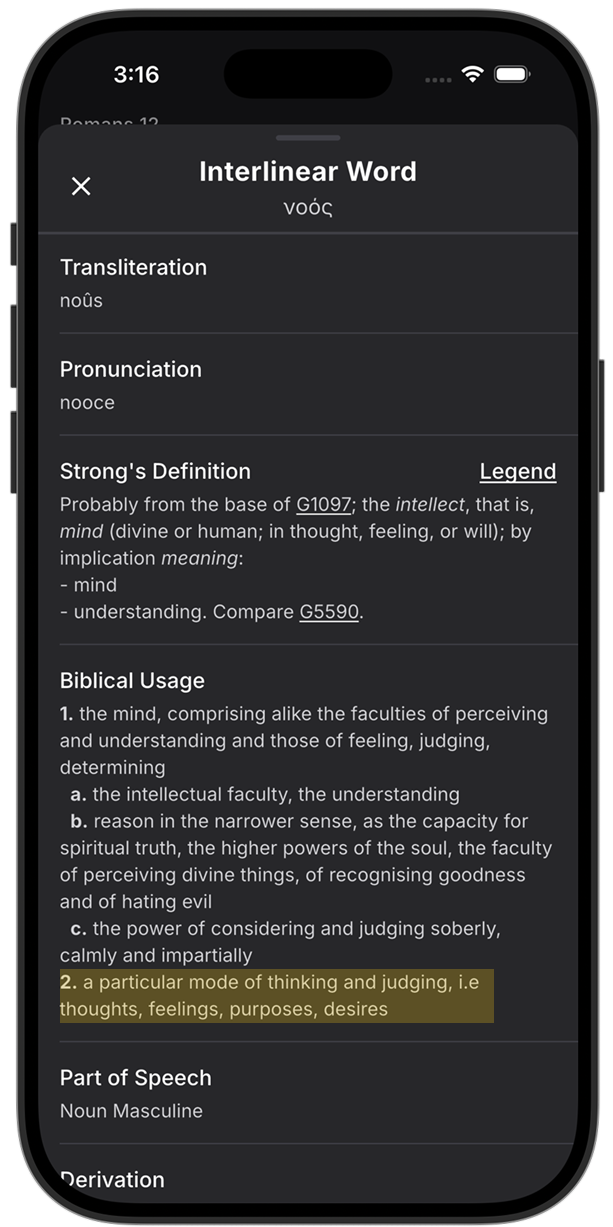
The word translated “mind” is connected to Strong's G3563. Its biblical usage includes “a particular mode of thinking and judging,” including a person's “thoughts, feelings, purposes, desires.” The mind here is not merely the thinking part of our brain. The word reaches into how we judge, what we feel, what we want, and what we live for.
Read a commentary

Matthew Henry writes, “Conversion and sanctification are the renewing of the mind; a change, not of the substance, but of the qualities of the soul.” In other words, renewing our minds does not mean receiving a physically different mind. It means that the qualities and direction of our inner life are changed.
Follow a cross-reference


Ephesians 4:22-24 tells believers to “put off your former way of life, your old self,” to “be renewed in the spirit of your minds,” and to “put on the new self, created to be like God in true righteousness and holiness.” This cross-reference gives us a fuller picture of renewal. Our thoughts, attitudes, and inner direction are to be transformed from our former way of life toward a new life that reflects God.
There is so much we can glean from one short phrase. Imagine how much more we might notice by carefully studying the rest of this verse.
Summarize what you observed
Once you have read the surrounding context, meditated on the passage, and studied it closely, summarize the passage and its train of thought in your own words. Writing the summary in a journal or notes app helps you articulate what you learned and gives you something to revisit.

Here is one possible summary of the phrase we studied:
God's mercies are so impactful that they should transform our thoughts, feelings, purposes, and desires from the former ways of the world toward a new life created to be like God.
Application
After reading and studying a passage, we should know more about God and His Word. But learning is not the end of a good Bible study.
Be doers of the word, and not hearers only. Otherwise, you are deceiving yourselves.
Application can take many forms. A passage might lead us to praise God, change how we think about something, treat another person differently, or get up and do or say something. A helpful application is concrete and measurable rather than vague or generic.
For Romans 12:2, “I should renew my mind” is true but difficult to act on. A more specific application might be: “I will identify one way I still think like the world, repent of it, and discuss it with a trusted spiritual leader who can help me replace that pattern with truth from Scripture.” Applications will differ from person to person, so choose a response that is faithful to the passage and relevant to your life.
Here are a few more practical examples from Romans 12:2:
- For the next seven mornings, I will read Romans 12:1-2 before checking social media and ask which source is shaping my thoughts.
- I will write down one recurring belief about success, appearance, or status that reflects the world's values, then find and memorize a passage that corrects it.
- Before making the decision I am currently facing, I will ask whether each option reflects what God calls good, pleasing, and faithful.
- This week I will ask a mature believer to point out one pattern in my attitudes or behavior that may need to change, and I will listen without defending myself.
Record your application in a journal or notes app, then revisit it in a week and honestly check your progress.


Prayer
End your study by praying over what you read. You can pray phrases from the passage, ask God to help you retain its truth, and ask the Holy Spirit to empower you to apply it faithfully. Your prayer does not need to be long or polished. It should be an honest response to God.
A prayer from this study might sound like this:
God, thank You for the mercy You have shown me. Reveal the ways I am still being shaped by the world, and forgive me for accepting those patterns. Renew my thoughts, feelings, purposes, and desires. Help me put off my old way of life and become more like You. Give me wisdom to recognize what is good, pleasing, and according to Your will, and give me strength through Your Spirit to live it out. Amen.
Keep studying
Studying the Bible takes time, but it is deeply enriching. SOAP gives us a simple pattern we can remember: read the Scripture, observe it carefully, choose a faithful application, and respond in prayer.
Hopefully, this method encourages you to slow down, dig deeper into the Word, and let its truth shape your life through the power that comes from God.